A little disappointed but not defeated, we found ourselves in Hualien, the starting point of this cycling loop along Taiwan’s East Coast. Well, we’d still managed to cover half of the planned route. The weather forecast for the coming days looked a bit better, and we were still eager to ride. So we thought, “Well, why not explore cycling Taroko National Park and camp there? It’s surely possible!” And that’s exactly what we did, spending 3 days and 2 nights there! Here’s our handy guide to visiting the magnificent Taroko Gorge, whether you’re on a bike, a scooter, or a bus!
We originally made this cycling trip through Taroko Gorge back in 2013, but the article has been fully revised and updated as of March 2026. If you notice any price changes or have additional information that might be useful, don’t hesitate to leave a comment!
What to do in Taroko Gorge?
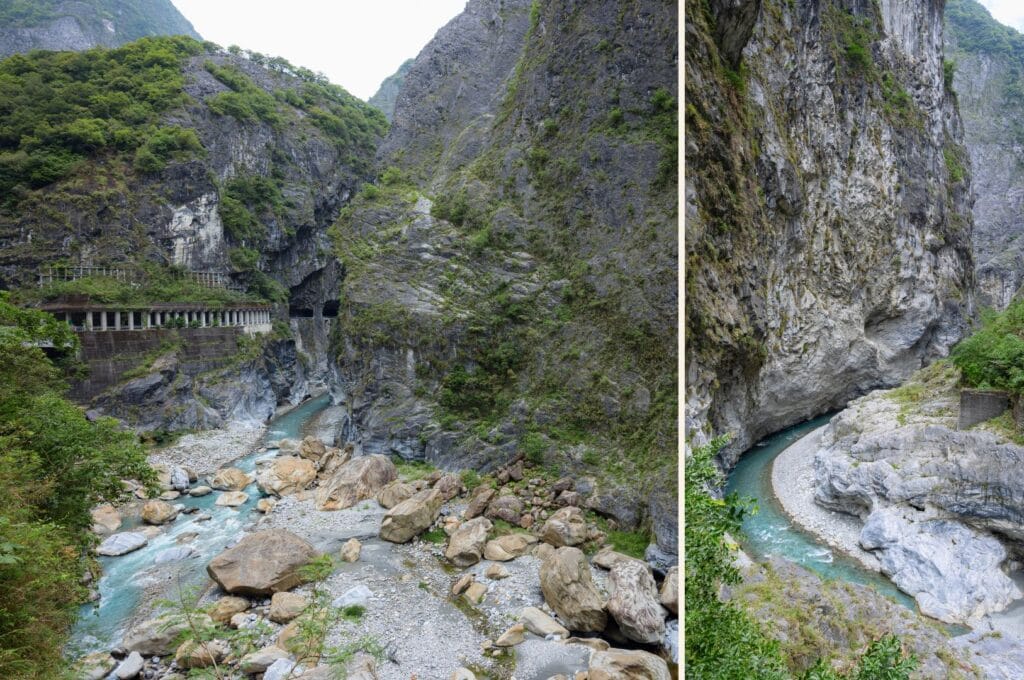
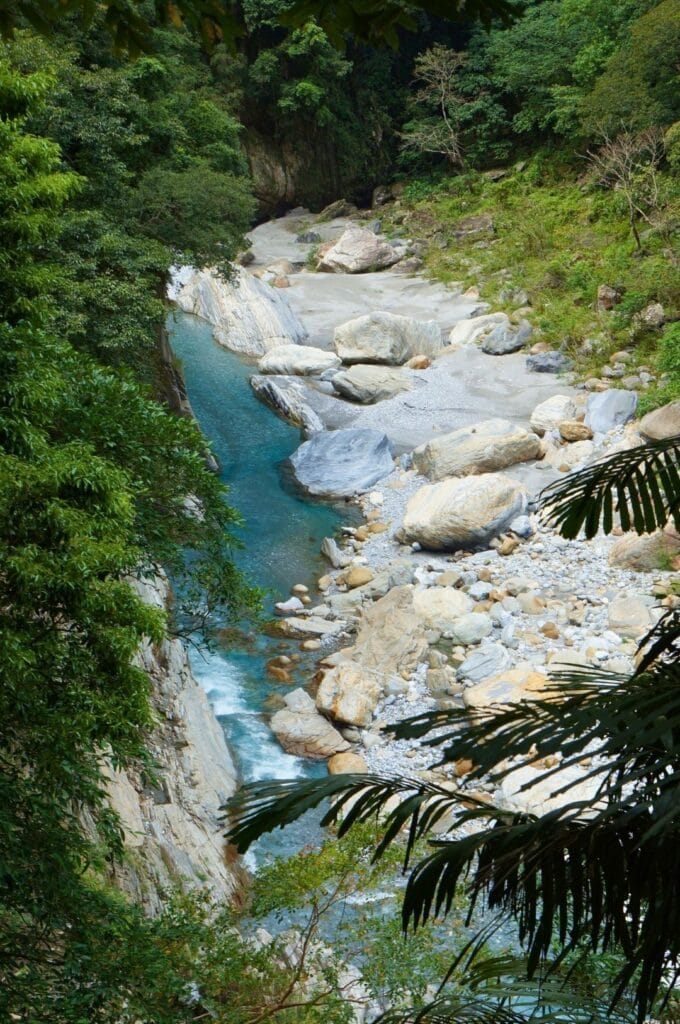
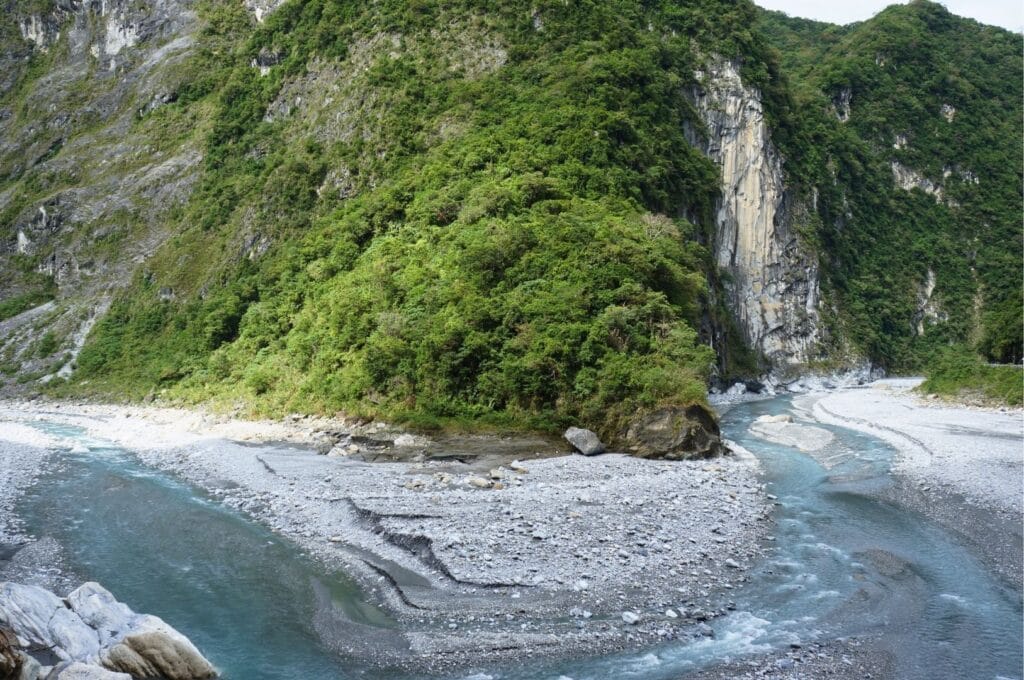
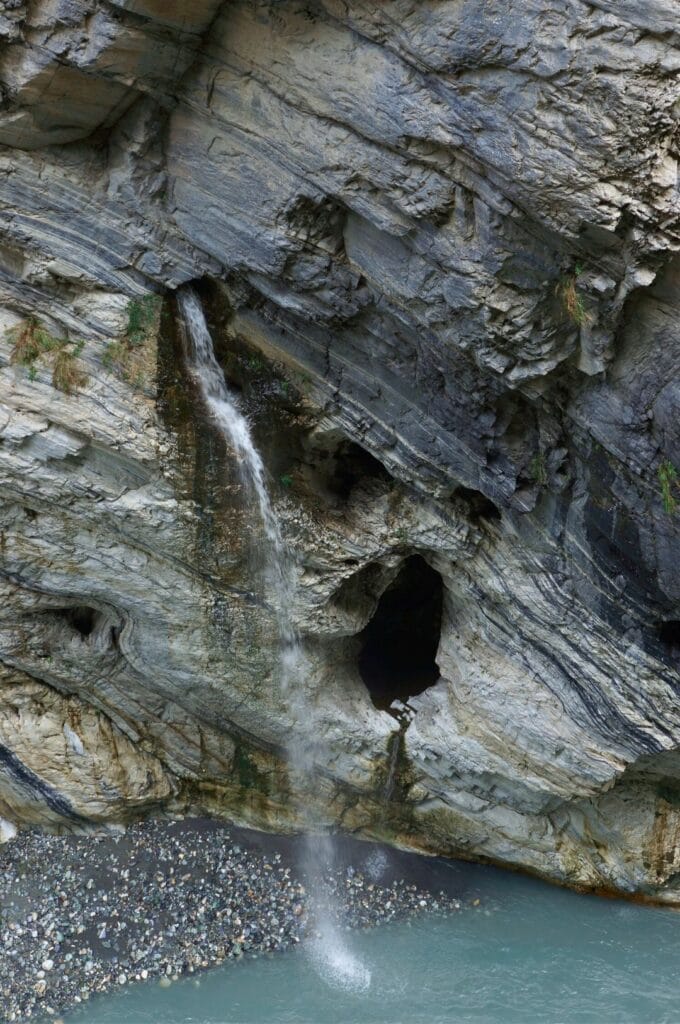
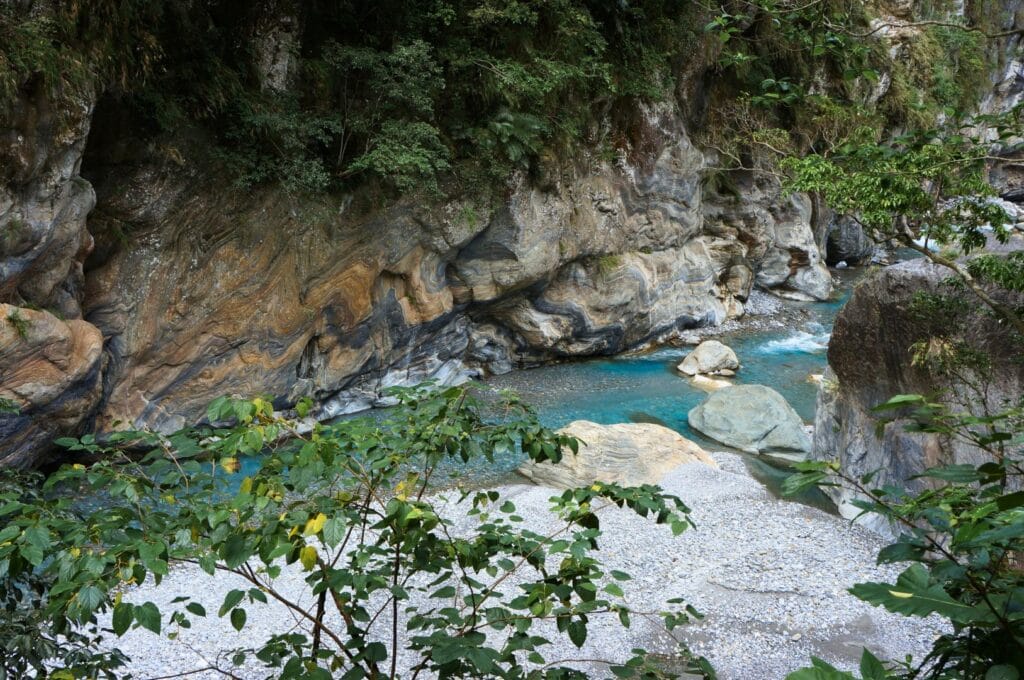
The national park is home to a 19-kilometer-long canyon, the Taroko Gorge. What makes it unique? It was carved out of pure marble by the movement of tectonic plates and the turquoise waters of the Liwu River! In addition to this incredible geological formation, the park features numerous peaks rising over 3,000 meters above sea level. We spent 3 days and 2 nights there, and honestly, we could have easily stayed longer — there’s just so much to see and do.
By staying at the campground, you’ll have easy access to most of the park’s hiking trails and attractions. I can’t recommend camping highly enough; it opens up a world of possibilities. And there are plenty: countless waterfalls, emerald waters, secluded temples, silvery reflections on the cliffs, hot springs, an incredible variety of rock formations, monkeys, colorful birds, and so much more…
Note: Make sure to stop at the main visitor center (Taroko National Park Visitor Center) at the park entrance to get the latest information on trail and road conditions. It’s open daily from 8:30 a.m. to 5:00 p.m., except on the second Monday of each month when it’s closed.
A major earthquake and typhoons struck the park in 2024, causing significant damage (landslides, rockfalls, and more) throughout the gorge. Restoration work has since begun, and the park is once again open to visitors. The main road is accessible again, and several trails and points of interest have reopened. Be sure to check the official website for the latest conditions before your visit.
Visiting the highlights
If you only have one day in the gorge and want to catch the essentials, we’d recommend getting around by car, scooter, or organized tour.
Below are the key sites listed from east to west, all accessible directly from the road or after a short, easy walk. We’ve included the distance between each stop and the elevation.
Qingshui Cliff
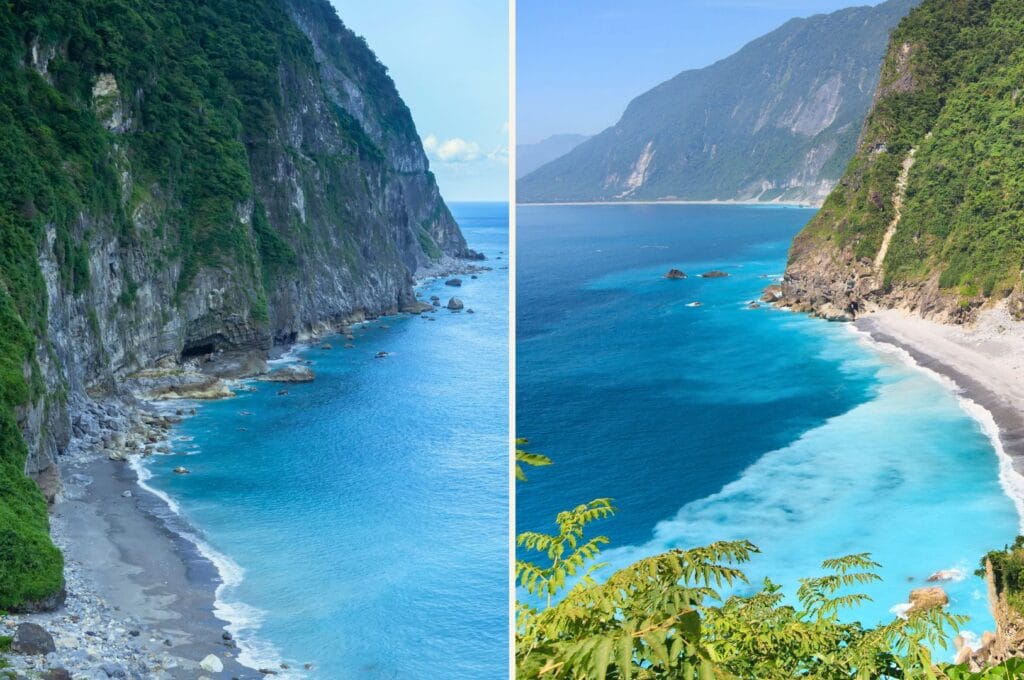
Among the 21 kilometers of coastal cliffs along Taiwan’s eastern shore, the Qingshui Cliffs are the most breathtaking in the country, rising a staggering 800 meters. Nearly perfectly vertical, they are considered one of Taiwan’s Eight Wonders! The contrast between the white marble and the turquoise water below is simply striking.
The Qingshui Cliffs are located 10 km north of the Liwu River estuary. Whether you’re traveling by bike, scooter, car, or on a guided tour, you can easily reach the Qingshui Cliffs. However, getting there by public transportation is a bit more complicated since there’s no stop at that location. You’ll need to take bus 1132 from the Hualien bus station to Chongde and then walk 5 km. Alternatively, you can take a taxi from Hualien.
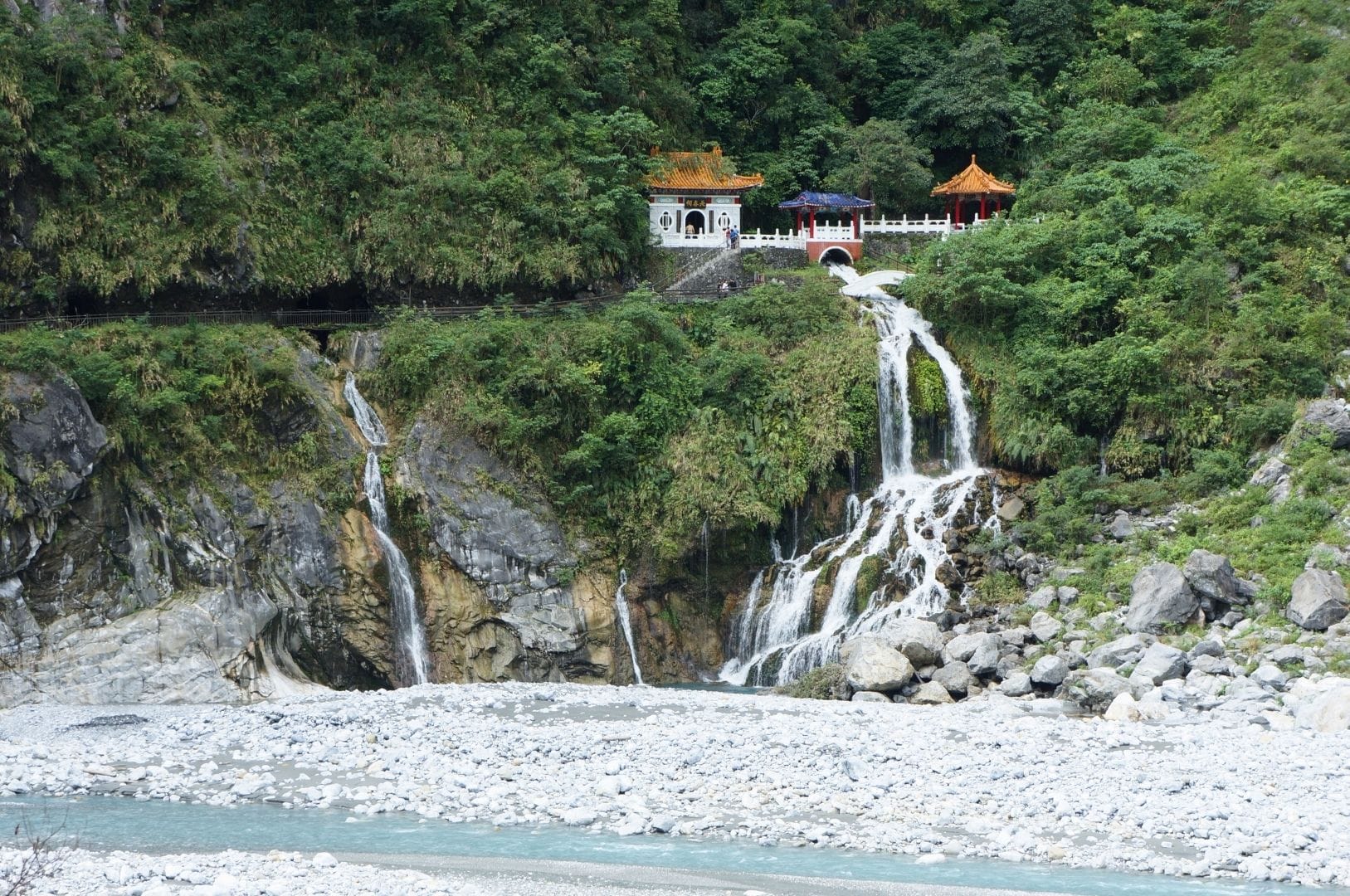
Changchun Shrine (or Eternal Spring Shrine) (3 km from the visitor center, 190 m elevation)
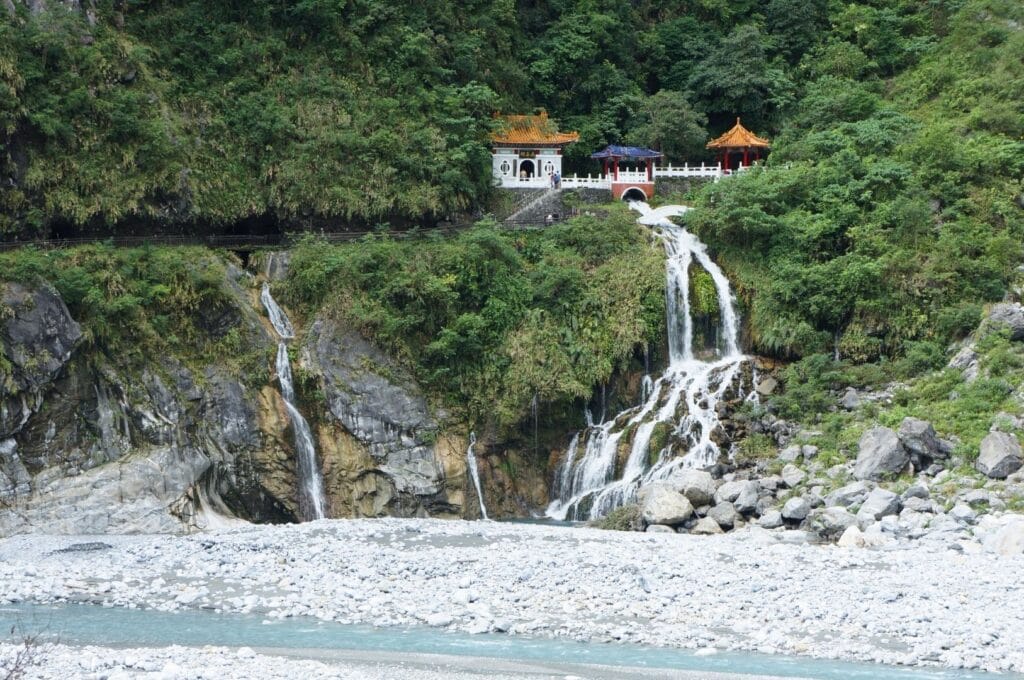
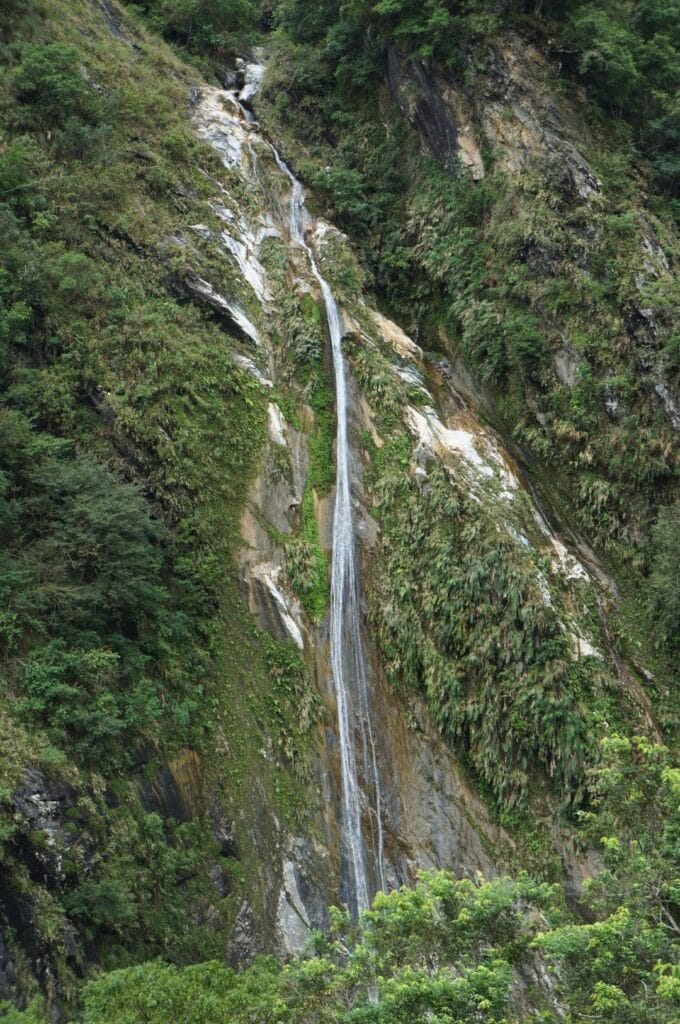
The Changchun Eternal Spring Shrine was built in memory of the 226 workers who lost their lives between 1956 and 1960 during the construction of Highway 8, which crosses Taiwan from one end to the other. Nestled among lush vegetation with a waterfall as its backdrop, the shrine has an undeniable charm — and it’s no coincidence that this image has become one of the most iconic representations of the park and the gorge!
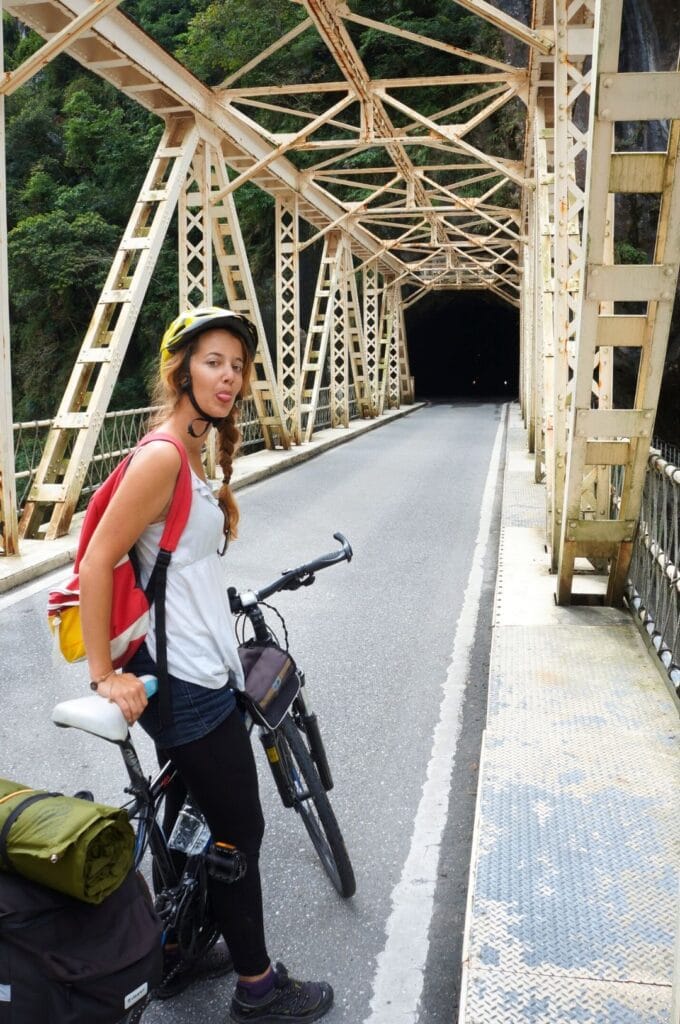
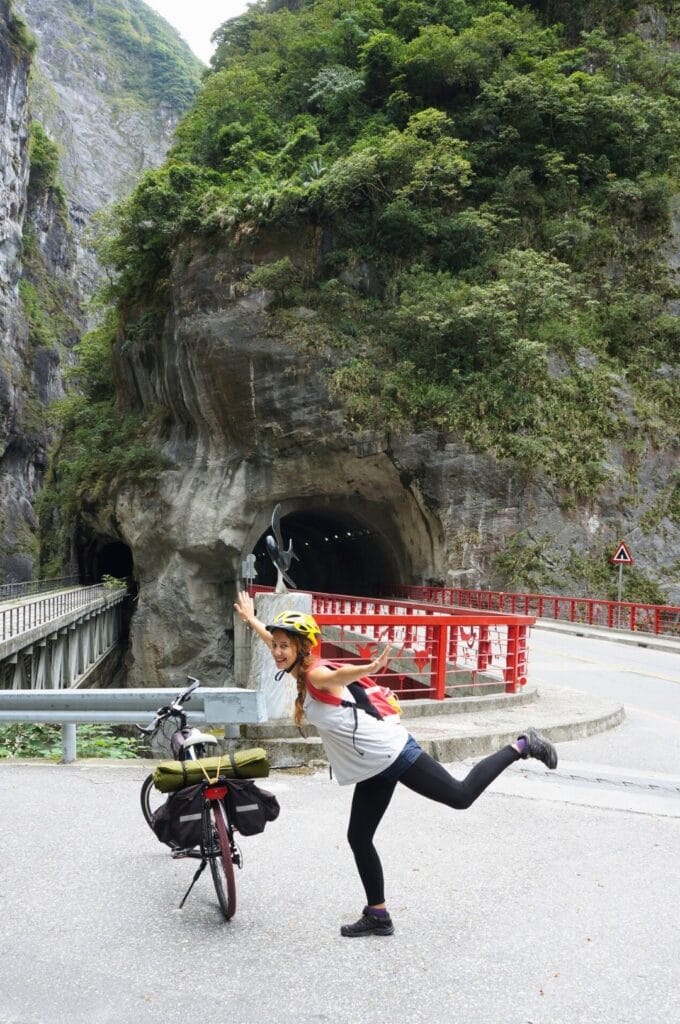
Some access roads in the park are one-way. This is the case for the road leading to the parking lot near the site. Basically, you need to cross the bridge, enter the tunnel, and turn left just before the end to complete a loop that goes over a red suspension bridge (formerly white!). Park in the lot just before the red suspension bridge. A short trail of a few hundred meters leads to the shrine through some caves from the far end of the bridge (you’ll see a staircase).
Buluowan (5 km, 345 m elevation)
In Buluowan, you’ll find another visitor center with parking. From there, you’ll have a beautiful view (Brawan Lookout) at the end of the longest and highest suspension bridge in the gorge, the Buluowan Cable Suspension Bridge.
Yanzikou Trail or Swallow Grotto (1 km, 280 m elevation)
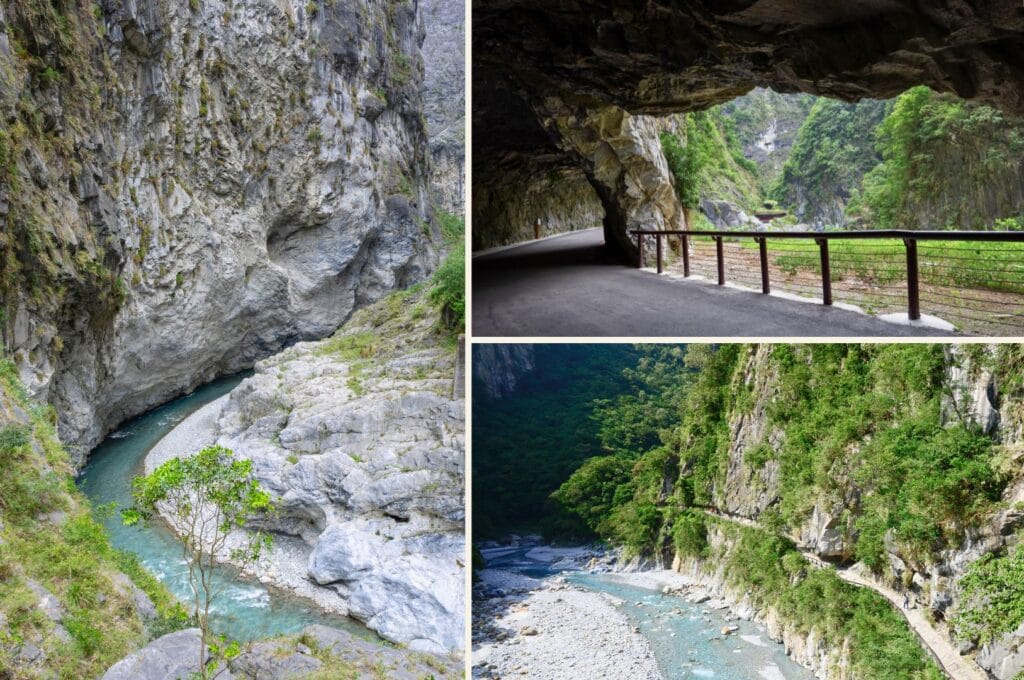
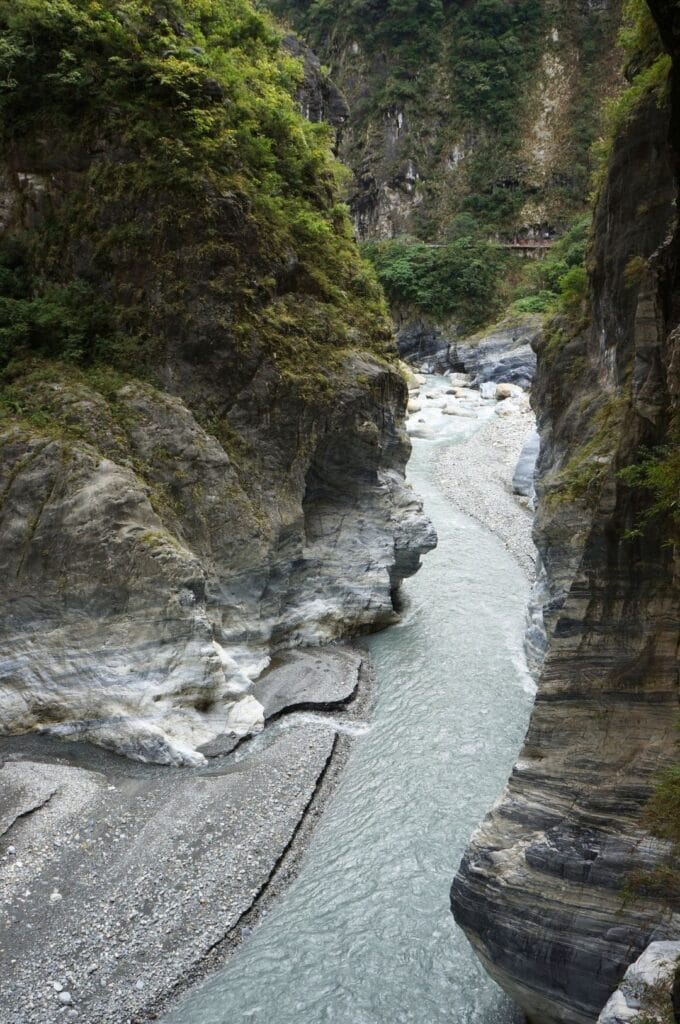
Swallow Grotto is another must-see attraction in Taroko. This 1.5-kilometer one-way walking trail passes through several caves and offers breathtaking views of the canyon, with the turquoise waters of the Liwu River flowing below. This route was formerly Highway 8 before it became too congested with visitors. A parallel vehicle tunnel was later built to ease the traffic.
A little further on, you will see a statue erected in honor of Jinheng, the engineer responsible for the construction of this section of the Central Expressway. He was tragically killed in 1957 by falling rocks while inspecting the damage caused by an earthquake. The Jinheng Bridge also pays tribute to the other workers who died when a temporary bridge collapsed.
Finally, a little further on, will you be able to spot the rock shaped like an Indian Chief’s head?
Note: We recommend wearing a helmet on this trail. You can borrow one free of charge at the visitor center.
Liufang Bridge (2.5 km, 440 m elevation)
This observation deck offers a direct view of Taroko Gorge and the double Liufang Bridge, which spans the cliff.
Tunnel of Nine Turns (Jiuqudong) (2 km, 500 m elevation)
The Nine Turns Tunnel is a pedestrian path that winds 1.4 kilometers (round trip) through the cliff face. Like Swallow Grotto, this was once a section of Highway 8, later converted for visitors to help manage traffic in the area. This is arguably the most scenic stretch of the entire gorge
In theory, the parking lot is reserved exclusively for bicycles and motorbikes… You’ll have to check when you get there to see if you can park. If not, you’ll need to take the park shuttle bus.
Lushui (3 km, 430 m elevation)
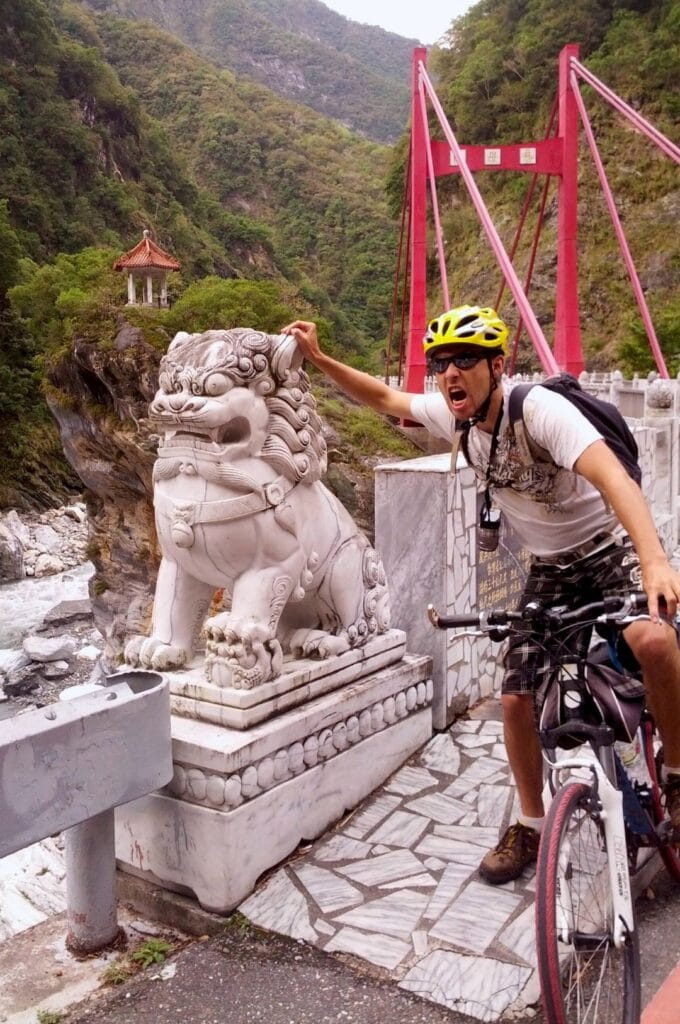
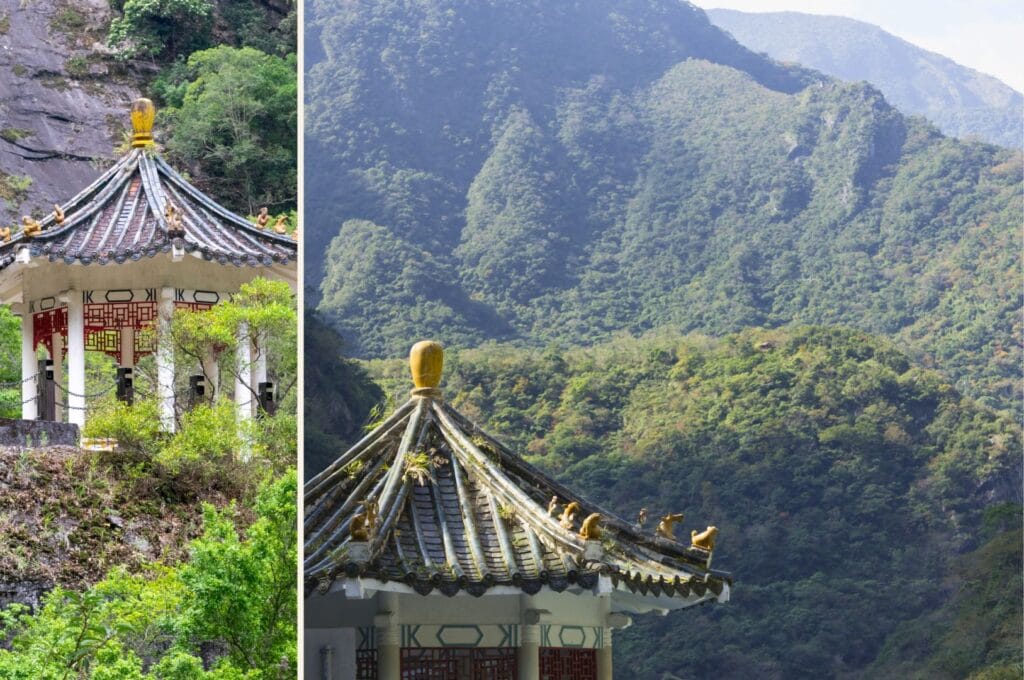
Just before Lushui, you’ll cross the Cimu Bridge (Motherly Devotion Bridge), which is easily recognizable by its red color and marble lions. Another unique feature is a marble pavilion erected on the left, atop a frog-shaped rock, designed to look like a crown for the animal. It was commissioned by a former president of Taiwan as a tribute to his mother. Well, while the Indian chief’s head is easy to picture, it’s harder to imagine an amphibian in this context!
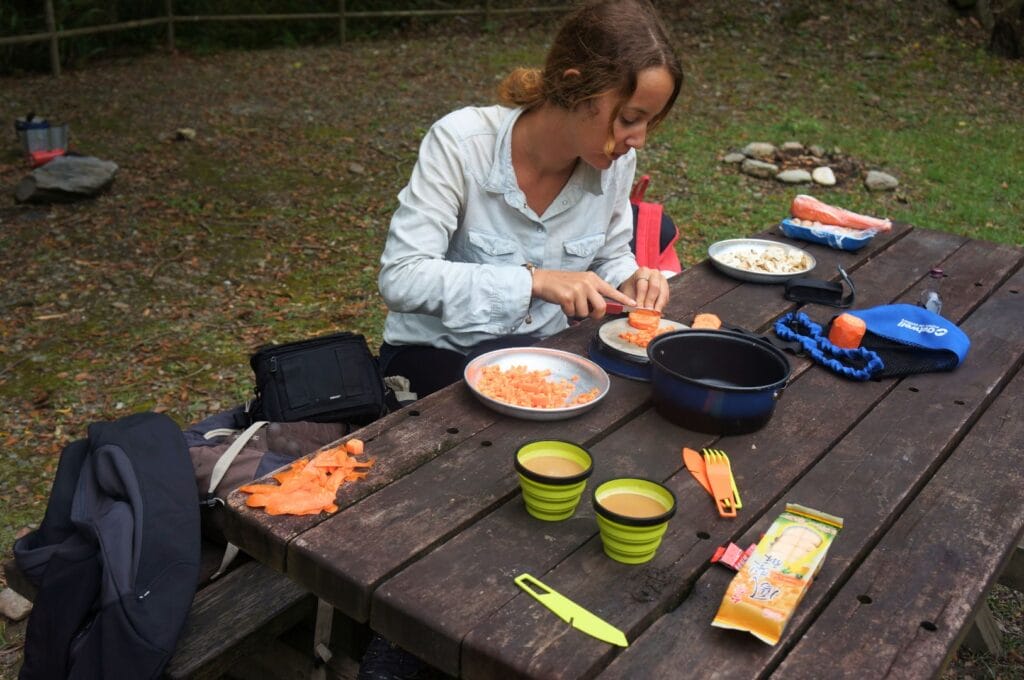
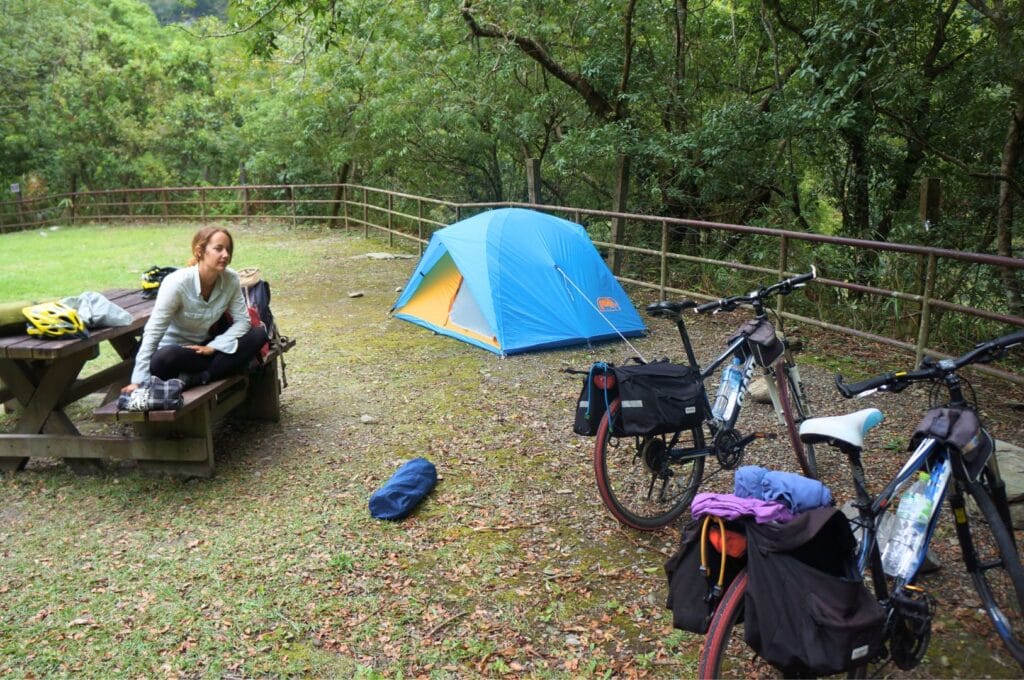
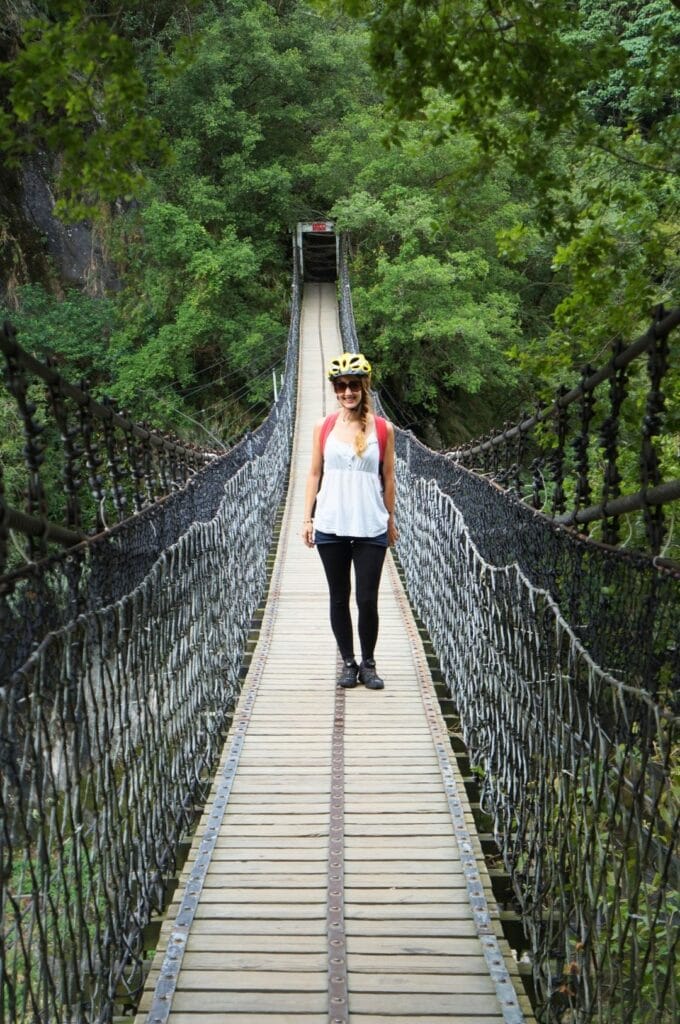
Then, in Luishi, this is where we camped. Note that there are no platforms for pitching your tent here, so if you prefer a harder surface, head to the Heliu Campsite located 700 meters before Lushui (here). We took the opportunity to take a short walk toward the Yue Wang Pavilion, on the riverbank next to the Heliu campground. From there, a suspension bridge leads to the other side, offering a beautiful view of the canyon.
Luishi also has another visitor center, which serves as the starting point for hikes. To learn more about the construction of Highway 8, the geology, and the formation of the canyons, be sure to visit the dedicated exhibition hall!
Tianxang (2 km, 465 m elevation)
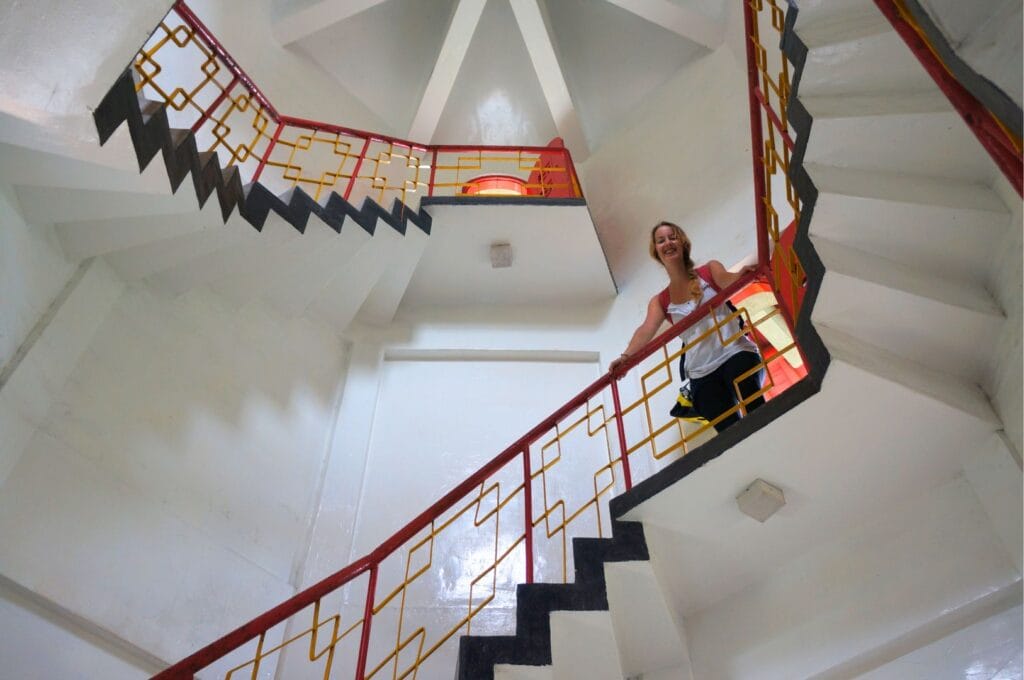
We then explored Xiangde Temple. To get there, park in the lot directly across from the white bridge at the entrance to Tianxang. Then, walk back the way you came to cross the Pudu Bridge—the red bridge flanked by two lotus flower sculptures. After climbing a few flights of stairs, you’ll arrive at the site. You’ll see the immaculate statue of Guanyin (the figure of compassion in Buddhism), the seven-story Tianfeng Pagoda, the golden statues of Kshitigarbha and Samantabhadra, and, of course, the Xiangde Temple itself. We really enjoyed this little, slightly more spiritual stroll!
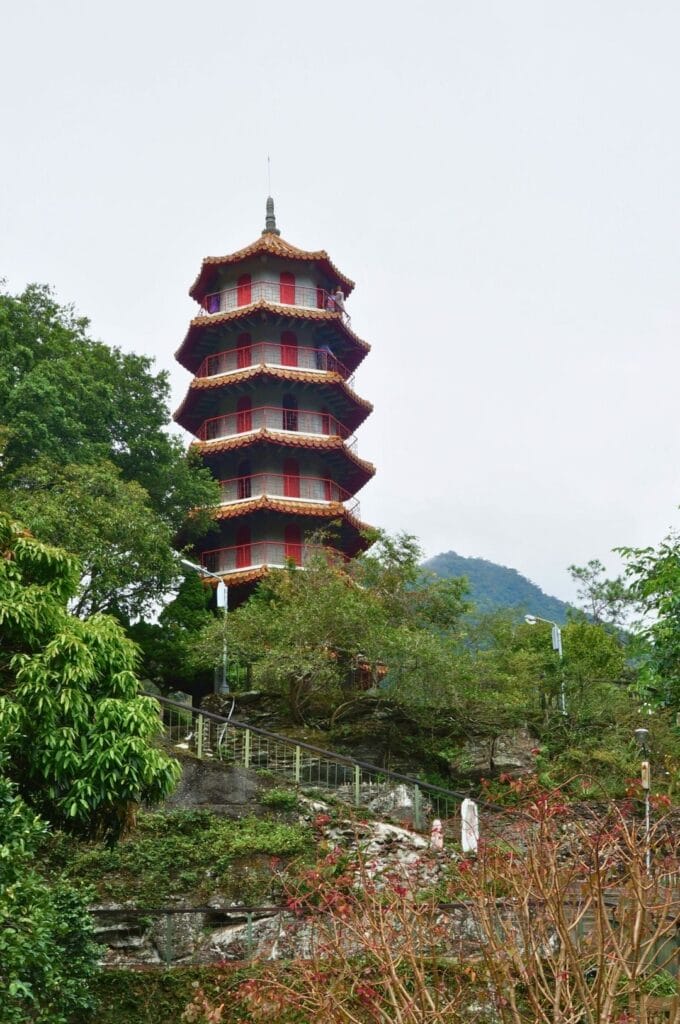
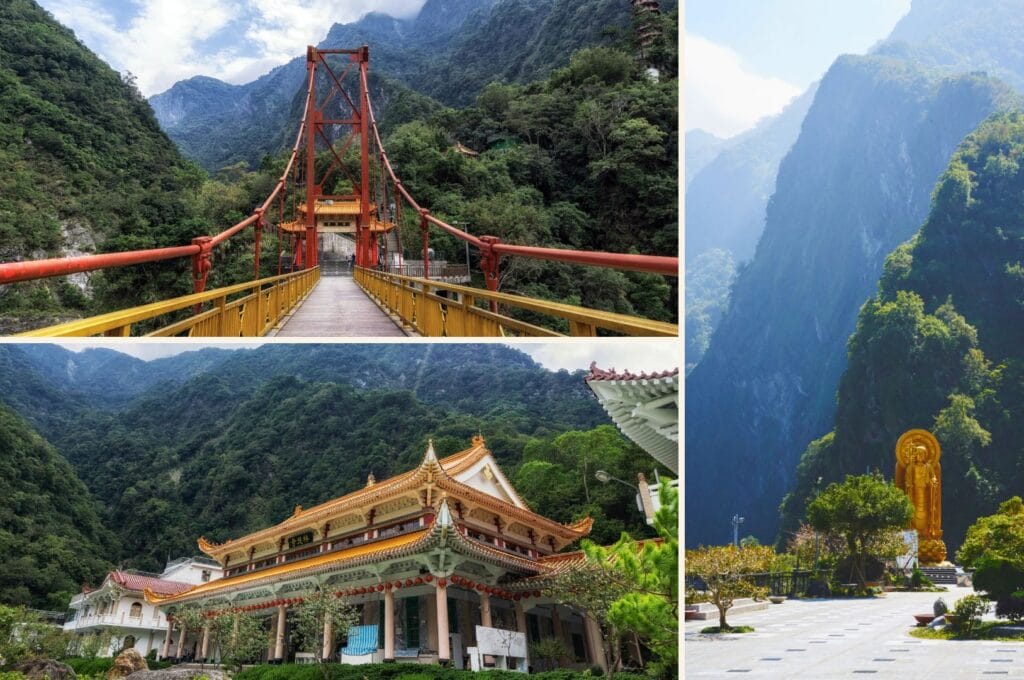
Tianxang is a must-stop for any visitor, whether traveling on a bike or a motorized vehicle. This village is also known for its two churches: the pretty all-stone Presbyterian church (Tien-Hsiang Church), located behind the superb Silks Place Taroko Hotel (take the street that goes around the hotel), and the Catholic church, 300 meters further on.
Finally, you’ll find another visitor center, a few restaurants, and two hotels.
About 3 km past the Tianxang parking area, you’ll pass through the Taishan Tunnel, and halfway through, the trail branches off toward the Wenshan Hot Springs. The path has technically been closed since a tourist died there. That said, many visitors continue to use it to soak in the pools. We’d rather be honest with you though — it’s extremely steep, rockfalls are a regular occurrence, the stone staircase is in very poor condition, and you need a rope to get down and back up. Our advice: don’t risk it.
Note: Beyond Tianxiang, there are fewer points of interest as you move away from the gorge. The road gains significant elevation, the trails lead to the park’s highest summits, and you’ll find several scenic viewpoints — including spectacular sea-of-clouds views from several stops. It might well be worth pushing on to the Hehuan Mountain Visitor Center near the summit for views of the park’s highest peaks.
Hiking
When you think of national parks and mountains, you think of hiking trails! If you’re planning to spend more than a day in Taroko Gorge, we’d recommend picking up the detailed hiking guide available at the visitor center for around 5 euros. There’s enough there to keep even a seasoned hiker busy for well over a week ;).
General information
Trails are rated by difficulty, from Grade 0 to Grade 5. Here, we’ve only highlighted hikes suitable for everyone—Grades 0, 1, 2, and some Grade 3 trails—that can be completed in a single day without a permit. For more information on trails rated above Grade 2/3 and multi-day hikes, visit the park’s official website.
Admission to the park is completely free. However, trails classified in the highest difficulty categories (such as Zhuilu Old Road) require a permit, which you can apply for online. Since each trail has a visitor limit, it’s best to apply several days or even a month in advance.
Trails
Here are the day hikes in Taroko National Park, from east to west. We have not included the short walks already described in the highlights section above.
- Xiaozhuilu: Starts at the visitor center at the park entrance; 2.6 km round trip; 200 m elevation gain. This trail involves numerous stairs leading down into the gorge.
- Dali-Datong: Starts at the visitor center at the park entrance; 15.6 km round trip; 900 m elevation gain.
- Shakadang: Starts at the visitor center at the park entrance; 8 km round trip; 600 m elevation gain. One of the gorge’s iconic trails and by far the most popular.
- Baiyang: Start from the parking lot past Tianxiang; 5 km round trip, 580 m elevation gain. Baiyang is another must-see trail in the gorges, featuring numerous caves, views of the great Baiyang Waterfall, and a visit to Water Curtain Cave (Shuilian Cave).
- Lushui: Starts at the Lushui Information Center; 3.6 km one way, 220 m elevation gain.
What else is there to do in Taroko National Park?
Attractions
Bilu Giant Tree (40 km, 2,200 m elevation)
No doubt about it, it’s a steep climb! We didn’t make it this far by bike, but it’s easy to get here by scooter, motorbike, or car.
Another highlight is the Bilu Giant Tree, an ancient conifer estimated to be 3,200 years old! Standing 50 meters tall with a trunk diameter of 3.5 meters, this fir tree is considered sacred in the park. There is a small parking lot just past the hairpin turn.
Dayuling (15.5 km, 2,560 m elevation)
Before you reach Dayuling, you might just get the chance to admire the famous sea of clouds at Yugong Cliff! There’s no parking there, so be careful. Otherwise, there are other viewpoints with small parking areas further along the way.
Dayuling is the junction where you can head north to Shei-Pa National Park and Lishan, or to Mount Hehuan.
Trails
As for hiking, despite the mountainous terrain in the western part of the park, there are a few easy trails to explore, mostly around Mount Hehuan.
- North Peak of Mount Hehuan: Start from the small parking lot by the roadside (here), 5.5 km round trip, 520 m elevation gain.
- Mount Shimen: Start at the small parking lot (here), 2.4 km round trip, 130 m elevation gain. This is undoubtedly the easiest trail in this part of Taroko National Park, and it’s also a great spot to watch the sunrise.
- Main Peak of Mount Hehuan: starting from the Wuling parking lot, 5.3 km round trip, 260 m elevation gain.
- East Peak of Mount Hehuan: Start here (there is a parking lot), 1.6 km round trip, 290 m elevation gain.
- Xiao Qilaishan Summit: Start here (there is a parking lot), 3.3 km round trip, 260 m elevation gain.
How to get to Taroko Gorge?
By bike
If you’ve read our article on cycling along Taiwan’s East Coast, you already know that the island is a cyclist’s paradise. Plenty of riders tackle the Taroko Gorge by bike. Highway 8 is well-maintained, though it doesn’t have a dedicated bike lane like the ones you find on the full island loop. That means everyone shares the road — buses, cars, motorcycles, scooters, and cyclists alike. As long as you stay alert and respect the flow of traffic, it works just fine, as it did for us :).
From Taipei
If you’re (really) up for it, you can start in Taipei. This could serve as the first leg of the Huandao, the tour of Taiwan we introduced in this article. That said, there are still 215 km between the two cities, and all the travel guides suggest breaking it up with an overnight stop in Jiaoxi, about 100 km from the capital.
From Hualien
Alternatively, the best option is to start from Hualien, the closest city to the national park. It’s very easy to get there from Taipei! You can find all the practical information (transportation, lodging, bike rentals, etc.) in the article dedicated to the East Coast.
Just keep in mind that reaching the campsite and visitor center at Tianxiang, located in the heart of the gorge, you’ll have to do a bit of climbing ;). The park entrance is about 25 km from Hualien. From there, it’s another 15 km to go before you reach the campsite, with some fairly steep sections along the way. I was actually really impressed by Fabienne, who powered through those sections without breaking a sweat! I can tell you that the beer we enjoyed after setting up our tent tasted completely different that evening. 😉
By motorbike
The gorges are very easy to explore by scooter! If you’re not afraid of Taiwanese traffic, you could ride the 200 km from Taipei. Otherwise, starting from Hualien is a good option. You’ll find several rental agencies around the train station. Do keep in mind that the roads can be quite narrow, so you’ll need to stay alert around buses and cars. If you’re not fully confident on a scooter, you might want to consider another option. Rental prices from Hualien are roughly 400–500 TWD per day.
By bus
If you prefer public transportation, it’s fairly easy to get to Taroko National Park. There’s no direct service from Taipei. So you’ll need to get to Hualien first and make your way to the bus station. There, you can either buy bus tickets one by one as you explore the gorges, or purchase a day pass (250 TWD) for unlimited rides. You can buy them at the Hualien bus station or at a 7-Eleven. Check to see if this is still the case today.
The first bus departs at 6:30 a.m. from the Hualien Bus Station, and the last return from the visitor center is at 7:20 p.m. The trip to Tianxiang takes about 1 hour and 15 minutes. Check the schedules for buses 1129, 1133, and 310. For destinations beyond the park entrance, bus 302 appears to go all the way to Tianxiang, with stops at Shakadang, Swallow Grotto, the Nine Turns Tunnel, and Lushui — though it departs from Xingcheng Station (TRA Xingcheng Station), the small town between Hualien and the gorge.
By car
Almost all the car rental agencies are located near the Hualien train station. Expect to pay around 2,000–3,000 TWD per day.
On a guided tour
Joining a guided tour is by far the simplest way to visit the park and gorge. We’d suggest this one for a group excursion from Hualien, or this one for a private tour from Taipei.
This article contains affiliate links to partner sites. When you use our links to book accommodations, a rental car, or an activity, you won’t pay any extra, but we’ll earn a small commission. This helps us provide you with free, independent, and ad-free content. Thank you for your support!
Where to stay in the Gorge?
Although most people usually stay overnight in Hualien and take day trips by scooter to the gorges, it’s actually perfectly possible to camp in the park—and for free, no less!
At one of the campgrounds in the park
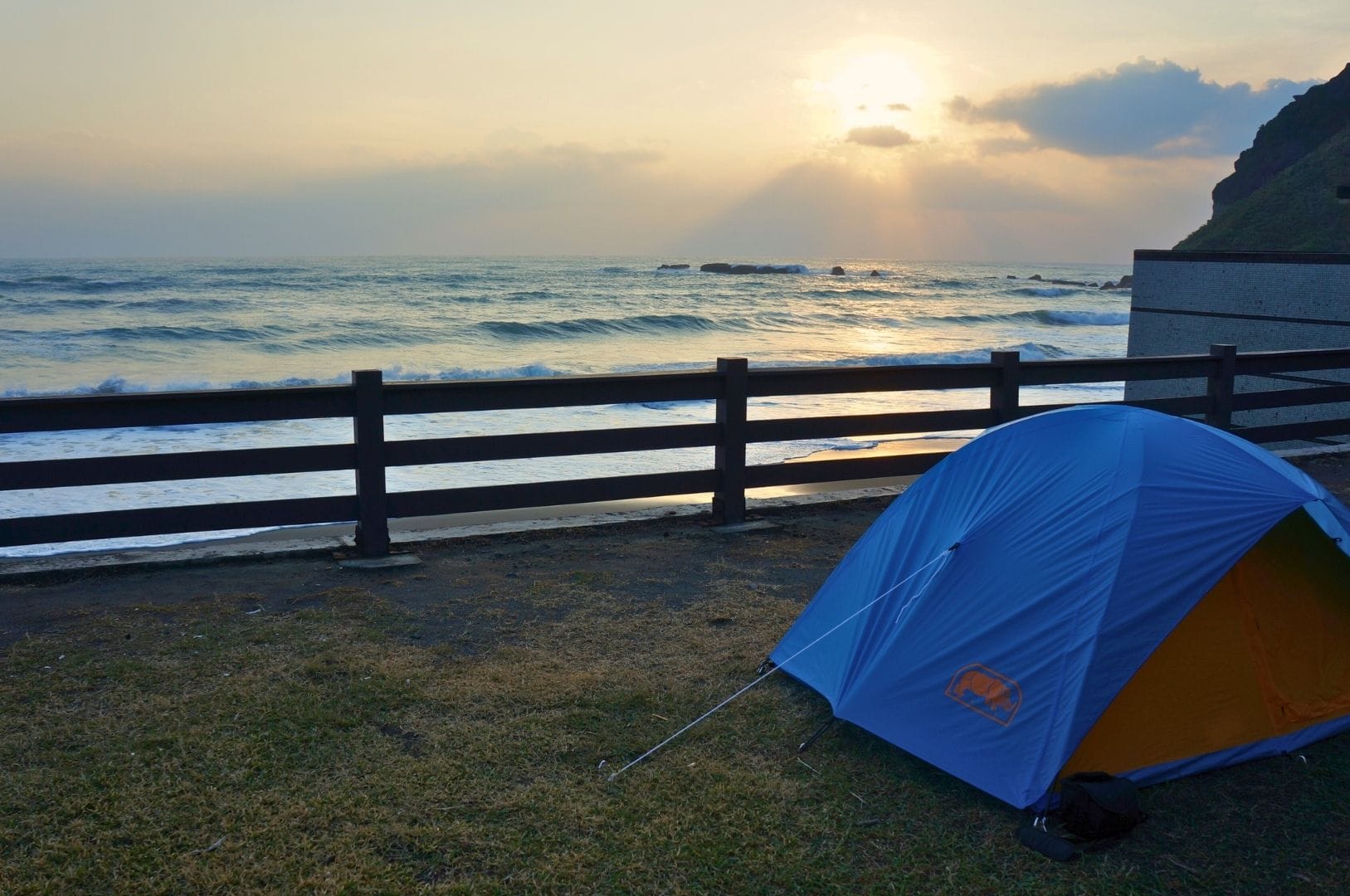
The park includes two campsites located in the same area, in Lushui, 15 km from the park entrance. These are the ones mentioned earlier in the article. The Heliu and Lushui campgrounds are practically right next to each other. Heliu has wooden platforms (and cold showers), unlike Lushui, where you pitch your tent directly on the grass. Also, Heliu charges a fee (200 TWD per tent), while Lushui is free. In both cases, you don’t need to make a reservation, and both have toilets on site.
At a hotel
Taroko National Park has about ten accommodations scattered along Highway 8. Due to damage caused by the earthquake, some of these accommodations have temporarily closed… Be sure to check Maps or Booking if you plan to book a room to enjoy the park for several days.
We’ve talked about camping in the park, but if our budget had allowed it, we might have treated ourselves to the finest hotel in the area — no question about it. The Silks Place Taroko sits right in the heart of the gorge, and the views are simply extraordinary. So if you’re looking to splurge for a night, you know where to go ;).
And that’s a wrap on Taroko Gorge! Would you like to explore it by bike? After these two incredible weeks in Taiwan, we headed onward to Hong Kong for a whole new experience. See you soon!
P.S. – To help you plan your next trip to the island, we’ve put together a handy guide to traveling in Taiwan. Enjoy!
Pin it

Join the discussion