
It’s been a while since I’ve written a personal thought here… but that’s one of the things I really like about blogging: having a space where I can express myself freely on a topic, take the time to put my ideas into writing, and share them with anyone who wants to read them, exchange thoughts in the comments.

Right now, I have to admit that there’s one issue that’s really on my mind: the way people search for information online is changing extremely rapidly. And this shift is happening at the expense of the people who create content on the internet (journalists, bloggers, content creators, authors, scientists, artists, etc.).
As you’ve probably guessed, I’m going to share my perspective on how AI is being rolled out very quickly everywhere by the Silicon Valley giants and, above all, without any respect for the original content they use to train their models.
Note: I’m writing this article because I feel that many people use these tools (and I’m one of them), but few people question this aspect of the ultra-fast deployment of AI. Furthermore, even though we often talk about it among bloggers and content creators, I see very few articles on the subject (and mostly in English, we write primarily in french). So here I go: first, it’ll be good for me to put all this down in writing, and second, it’ll be my modest contribution to highlighting what we’re experiencing as creators of small, independent websites in the age of AI.
The Facts
We often discuss this topic with other French- and English-speaking bloggers. And I get the impression that virtually every independent content creator I’ve spoken with has been negatively impacted to some degree since 2023 (English-speaking creators even more so, since they’re always the first to be affected).
It started with major updates to Google’s algorithm in 2023–2024 (HCU, or “Helpful Content Update” in September 2023, followed by others in 2024) that negatively impacted many small websites, benefiting large institutional sites or forums like Reddit.
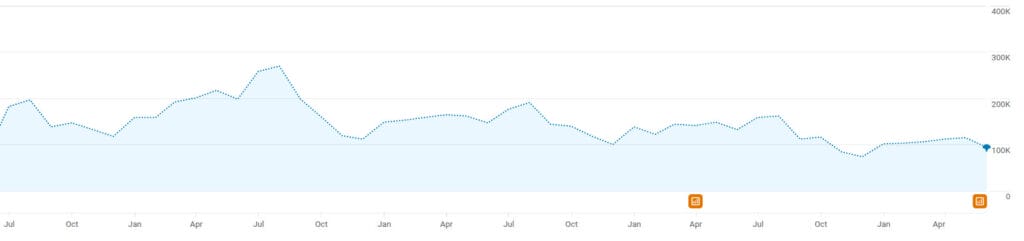
So it’s true that many websites were gaming the SEO system with articles heavily optimized for keywords, clickbait titles (like “the ultimate guide to,” “The Top 10,” etc.) or by displaying tons of ads and affiliate links that ruin the user experience in favor of ad revenue. You might say that not many people will miss these sites (and I agree with you). But these updates impacted a wide range of websites, and many blogs that I considered to be of fairly good quality (meaning they didn’t over-optimize all their content) have sometimes seen their traffic drop drastically.
As far as we’re concerned, we’ve always made it a point of honor to prioritize content quality over SEO (meaning we write for our readers rather than for search engines) and to avoid turning our blog into a Christmas tree crammed with all kinds of ads. But despite all that, even though we haven’t been very negatively impacted by these updates, we certainly haven’t been positively impacted either.
The Impact of AI on Content Creators
As you’re no doubt aware, AI is revolutionizing many fields, which could lead to major improvements in a wide range of sectors such as medicine, research, code development, education, and so on… But this revolution also raises many sensitive issues, such as weapons development, security breaches, AI control, job losses, and so on… which often seem to be sidelined in favor of the rapid development of these technologies.
In the following paragraphs, I’m not going to talk to you about all these incredibly important issues (perhaps selfishly), but rather focus on what directly concerns us: The drastic changes brought about by AI in the way people search for information and the direct impact this has on us, content creators (as well as the impact it could have on information in general in the near future).

At Alpiness (our coliving space), we welcome people aged 25–45 who work online and are generally more tech-savvy than average. As a result, over the past two to three years, we’ve had the chance to see just how quickly people have embraced AI tools (ChatGPT, Claude, Gemini, Perplexity) for a whole range of purposes, such as:
- create a workout schedule for the coming months
- a kind of coach or confidant with whom you can easily share whatever’s on your mind
- get quick answers to every possible question you can think of
- plan trips
- improve productivity at work (this is particularly evident among some developers who no longer write much code themselves)
- automate a whole bunch of tasks using AI agents
- Etc…
In general, I’m pretty curious and the type of person who’s quick to adopt new technologies. And I sincerely believe that AI can have a positive impact in many areas. But as you can imagine, points 3 and 4 on this list directly affect us in terms of our work on this blog:
Why would internet users still visit a site like ours if they can ask their questions to an AI tool that can provide them with a concise answer based on what it knows about our site (and the internet as a whole)?
The answer is simple: many people won’t do it anymore because they’ll get an answer much faster by asking Claude, ChatGPT, and the like. (Even if the answer isn’t necessarily the best, it will be delivered with great confidence by the chatbots.)
You might say that we have to move with the times and that these tools are simply more effective for finding information. And I’m the first to be impressed by what they’re capable of! But let me still tell you about the theft of information on which AI model training is based, as well as the risks involved in such control over information by a few powerful players.
The Massive Data Theft
One of the cornerstones of these tools is the quality of the data used to create them! I was listening to an interview one day with the CEO of Mistral AI (France’s leading artificial intelligence company), who emphasized that data quality (along with computing power) was the key factor in training their AI model. Sam Altman himself admitted that it was impossible to train good AI models without using copyright-protected data.
So, to put it simply, here’s a summary of the situation:
- OpenAI, Google, Anthropic, and others use content from millions of websites and digitized materials (books, scientific articles) without asking anyone for permission to train their AIs, completely disregarding intellectual property rights (that’s really what they did in the beginning).
- They create interfaces that answer users’ questions using AI and have built an entire business around monetizing that knowledge
- This results in a decrease in the number of visitors to websites and, consequently, a significant erosion of the revenue streams of the people who created the original content used to train these tools.
You don’t have to be a genius to realize that this isn’t very ethical, and probably isn’t very legal either. In fact, there are numerous cases currently pending, and by the end of 2025, Anthropic, which always presents itself as the ethical player in the AI field, had already been ordered to pay $1.5 billion for violating copyright laws while training its models.

Nothing new, though: it’s the approach popularized by Silicon Valley startups: “move fast and break things”, which involves developing new technologies at any cost and as quickly as possible to gain a dominant position in the market… but without regard for potential consequences, laws, or ethics (they prefer to deal with problems later through their lawyers).
Everything suggests that the executives of these platforms were well aware of the issues surrounding data protected by intellectual property rights when training their models… but that they decided to use it anyway because, in the race for AI, asking for permission would have put them at a competitive disadvantage. And now that the valuations of these companies are reaching record highs (1,000 billion dollars for Anthropic, 4,500 billion for Google), even fines of 1.5 billion are no longer a significant burden for them.
However, given AI’s incredible potential for both good and evil, we can justify questioning this approach. It’s actually quite ironic that the CEO of Anthropic (which again, positions itself as the ethical player in AI) is now calling for a slowdown in AI development to reflect on the new threats that the latest models could pose to society… Let’s just say they could have already started thinking about solutions to train their models on non protected data or by compensating the creators.
And what about Google?
Google stands out from all other AI players because it still accounts for 90% of online information searches. To stay competitive in the AI race, Google has therefore begun integrating its Gemini model (which was a bit behind for a long time but is considered one of the most powerful in 2026) into many of its products, including, of course, its search engine. This is a major advantage over other AI players that do not have this platform.
As far as we’re concerned, most of the people who visit our site still come from Google (80% of our traffic). These are mainly people looking for information on specific destinations to plan trips, hikes, and so on. They ask Google their questions, and Google redirects them to the most “relevant” websites, ranked by a sophisticated algorithm known only to Google.
Since we started blogging nearly 15 years ago, there haven’t been any major changes in how this system works. Basically, you ask Google a question, and it directs you to the sites that offer the best answers according to its algorithm (while showing you a few ads along the way 😉 Google’s not crazy, lol). But by writing articles that were as comprehensive as possible on specific topics, sharing our travel experiences as best we could, maintaining a technically clean website, and so on, we were still able to stay visible on Google.
But that was before Google gradually rolled out AI Overview and AI Mode in its search engine (starting in early 2025).
AI Overview and AI Mode
You may not see them yet in France (this is a special case unique to France, and for legal reasons, Google has not yet rolled out these features there), but these two features have already been implemented in more than 200 countries.
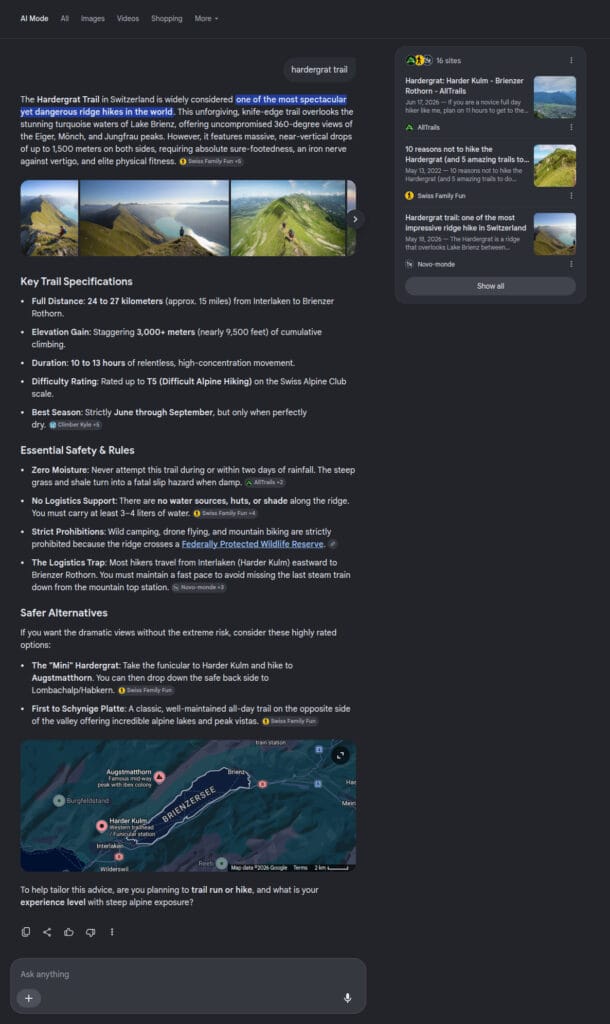
To give you an idea of what a game-changer this is for us, here are a few screenshots of what American users see when they search for terms where we rank very pretty good on Google:
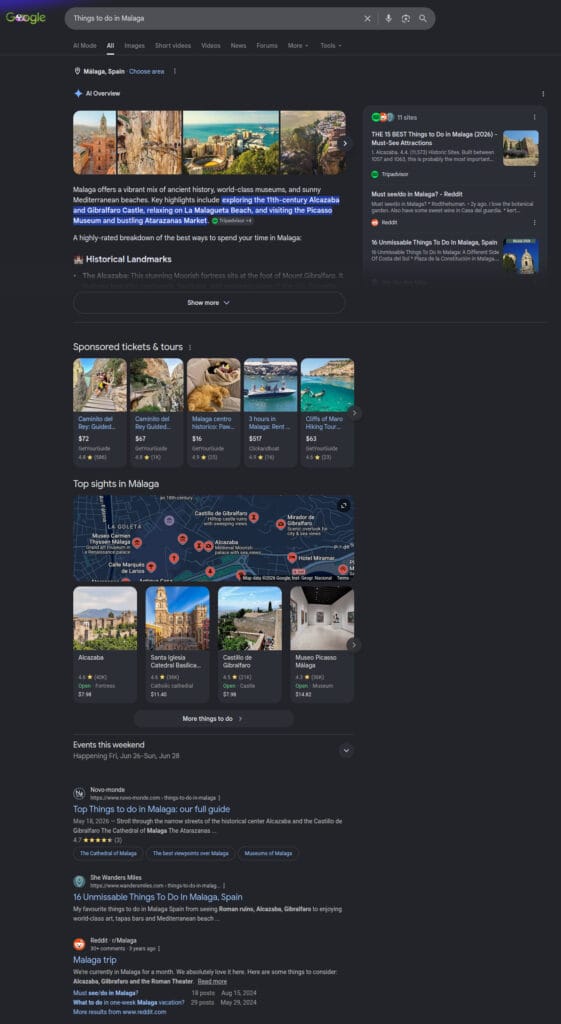
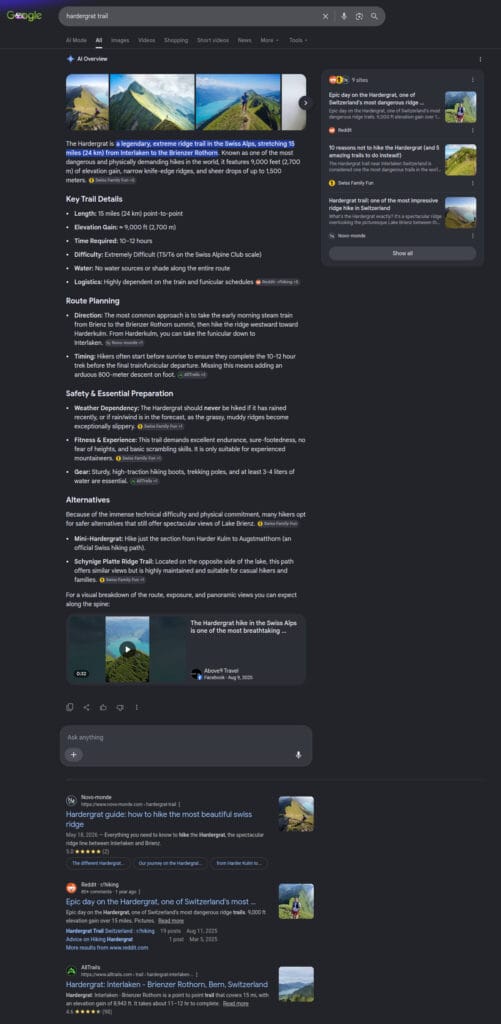
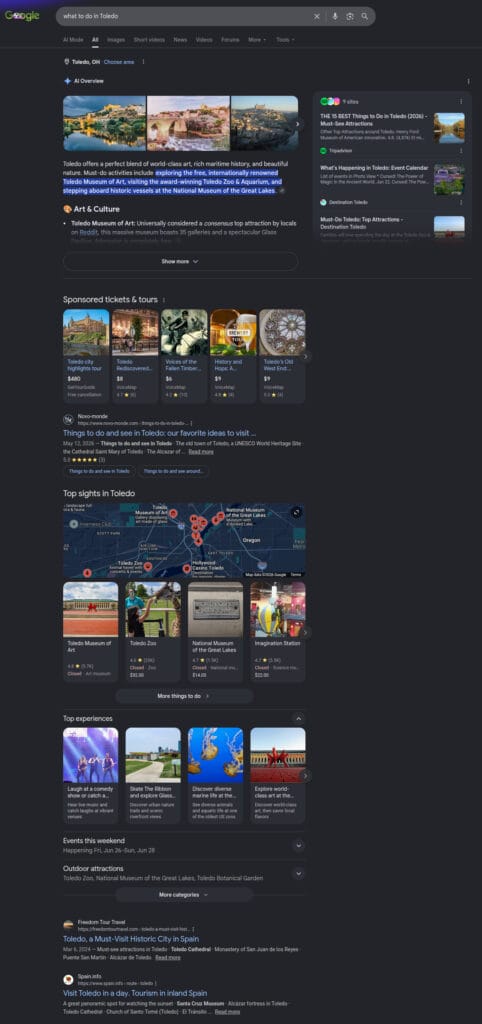
By default, users now see an “AI overview” above their search results. You don’t need to have conducted in-depth case studies to understand that users click much less frequently on search results that trigger an AI overview. But to give you an idea of the impact, here are a few figures I’ve gathered here and there:
- These summaries appear in about 50% of Google searches
- CTR (the percentage of people who click on a link) drops by 60% when an AI preview appears in search results
- The percentage of search queries that generate no clicks is reported to have increased from 54% to 72%
Obviously, this trend threatens the survival of many websites, whether they’re news sites or travel blogs like ours. Google may claim that while the volume of traffic coming from its search engine is declining, its quality is increasing (meaning that readers who decide to click on a link in an AI-generated snippet are more qualified). Nevertheless, the business model of many sites relies in part on advertising (which is proportional to traffic) or affiliate marketing (which is our case), and their revenue will be significantly impacted by the drop in traffic.
Finally, just a quick note about the AI mode you may have noticed in the photos above. It’s a chat interface with Gemini, similar to Claude or ChatGPT, that’s directly integrated into Google to answer your questions. For now, the AI preview is displayed by default above the traditional links (though if you click on the AI preview, you can already chat with Gemini), but it’s a safe bet that one day AI Mode will become Google’s main interface. And when that day comes, it won’t be 72% of queries that generate no clicks… it’ll be 95%. That will spell the death knell for all news websites!
The risks posed by these changes
Beyond the fact that these changes will have a devastating impact on the work of content creators of all kinds, they raise issues that, in my opinion, are even more important.
The Concentration of Access to Information
Do we really want access to information to be controlled by a handful of interfaces (Gemini, ChatGPT, Claude) owned by American tech giants? I doubt it… Generally speaking, such a concentration of power doesn’t bode well. Instead, I think we should fight for greater diversity in media, perspectives, and sources.
It is also very telling that these companies do not want to take responsibility for what their chatbots tell users, in order to avoid any legal liability. They are fully aware that their tools can make mistakes, a problem that is exacerbated by the fact that AI systems are poor at expressing uncertainty (meaning they sound very convincing, even when the answer is wrong. If you use these tools, you’ve surely already noticed this tendency).
All of this creates a pretty explosive mix in the context of a frenzied AI race, where some players are investing astronomical sums (we’re talking hundreds of billions of dollars) to ensure that people can no longer do without their tools.
Homogenization and the Vicious Cycle of AI-Generated Content
AI models do not provide the correct answer to a question, but rather the answer that is statistically most likely based on their training data. This bias systematically favors the majority viewpoint, while slightly less conventional perspectives are becoming more and more invisible.
Furthermore, even though the first generations of models were indeed trained on human-generated data, the internet is now flooded with AI-generated content. New models explore the web and thus retrieve more and more AI-generated content for training, thereby amplifying the homogenization bias I just mentioned.
That is the irony of the situation for content creators in the age of AI. These models need authentic content that represents the full diversity of human perspectives so they don’t slowly converge toward some kind of “average truth.” But at the same time, they put so much pressure on creators’ business models that there will be less and less human-generated content available for training in the future, thereby amplifying the vicious cycle.
Conclusion
To be honest, I’m having a little trouble drawing a conclusion, and I’m not under any illusions. Even taken as a whole, journalists, bloggers, artists, and other content creators are no match for the tech giants battling it out in this frantic race toward AI.
There will be good and bad outcomes, winners and losers, as a result of this ongoing revolution. As far as we’re concerned here on this blog,I unfortunately have the feeling that we’ll be on the losing side. And it really breaks my heart to see that the visibility of novo-monde, which we’ve built over the past 15 years with Fabienne (and Hélène in recent years), could disappear practically overnight. I feel as though these big tech companies have stolen the value of the thousands of hours of work invested in our blog without asking for our opinion.
With these tools, it’s now possible to create websites and content automatically and in unlimited quantities extremely quickly. You can automate just about everything, from the technical aspects and topic research to content creation, SEO, and sharing on social media and via newsletters. In fact, we’re seeing a proliferation of systems that put websites virtually on “autopilot,” flooding the internet with AI-generated content.
But honestly, what’s the point! What we love about blogging, what gives meaning to what we do, is sharing our experiences and our perspective on a destination, a road trip, a hike, or a specific topic, as I’m doing today… We don’t really see the point or the value in letting these tools create content for us. And the authenticity of our perspective is perhaps our only chance of not completely disappear (and even then…).


Note: That said, I’m not completely opposed to AI… When it comes to blogging, I definitely see the value of these tools, for example, for dictating posts instead of typing them (personally, I don’t type very fast), translating our content more quickly, helping me with SEO, correcting spelling, or even handling all the technical aspects of the blog (since AI tools are very effective at coding).
In conclusion, chatbots are revolutionizing the way people search for information. While the attention economy has grown alongside the rise of social media (with the many harmful effects we’re all familiar with), the rise of AI chatbots is creating an answer economy.
AI companies are spending billions to win your trust and create mega-apps that answer all your questions. It’s a way of delegating intellectual effort, in a sense. It’s very easy to use, seamless, and extremely addictive. These interfaces answer questions with such speed, clarity, and certainty that the more you use them, the harder it becomes to do without them… hence their immense economic potential (subscriptions, product placement, affiliate links, etc.).
It is, in fact, legitimate to ask about the long-term consequences of always having such a tool at our fingertips. If social media and its “attention economy” have created addictions, cognitive bubbles, and divided society, who knows what chatbots and the “answer economy” have in store for us. Perhaps a generation of people who no longer think for themselves, a decline in the diversity of viewpoints, the disappearance of doubt…
As I mentioned earlier, 80% of our readers are looking for information about a trip, a hike, or a specific destination… and most of these people will soon stop visiting our site to find answers to their questions, simply because it will be easier and more convenient to ask Claude or ChatGPT directly.
There will always be a small percentage of people who are looking for a human and authentic perspective, who will subscribe to our newsletter, who won’t delegate all their travel planning to a chatbot… But the business model we chose, affiliate marketing, because it gave us the most editorial freedom (even though we do have a few small products like our books and e-books), won’t be viable for much longer, in my opinion.
So what should we do??? We could create more products, lock some of our content behind a paid subscription, or lean more toward influencer marketing, organizing group trips with readers, doing product placements… or even offering coaching 😉 . But if you read our blog often, you probably know that’s not really our thing. The way things are going, I get the feeling we’re going to focus more and more on our coliving space while continuing to blog, of course, but for fun and with fewer financial expectations. And that’ll be just fine, too.
I’ll wrap it up here for today, but feel free to let me know what you think in the comments! If you’re also a content creator, how have all these changes affected you? I’m curious and would love to discuss this with any of you who’d like to.
Some interesting references
- A speech on journalism in the age of AI by the president of The New York Times
- 2 blog posts (here and here) from bloggers on the impact of AI on their work
Pin to Pinterest



I like your in depth article on AI and recent Google search impacts to yours and other bloggers sites. I can say one thing and that I have abandoned Google as search engine on my phone- now using “Duck Duck Go” athlete advice of 20 something younger people that advised its the best for avoiding all that BS with the Google type algorithms pointing searches to what they want you to see. So if more people switch search engines the better off you will be….
Hey Weselley,
Thanks for your message. For now it’s a really small portion of people moving to other search engines like duck duck go… But yeah who knows how it’s gonna evolve in the future. Of course my blog post sounded pessimistic but I do hope to be positively surprised by what’s coming 🙂
Thanks for a great article and totally agree with everything said. The irony of AI companies “training” their models on blogger content is that once bloggers no longer find it worthwhile to publish content, how will those same AI models get accurate, useful information. Right now the AI models are in the middle of a lush, green pasture, devouring every blade of grass they see. What happens when the drought comes and that pasture slowly turns brown?